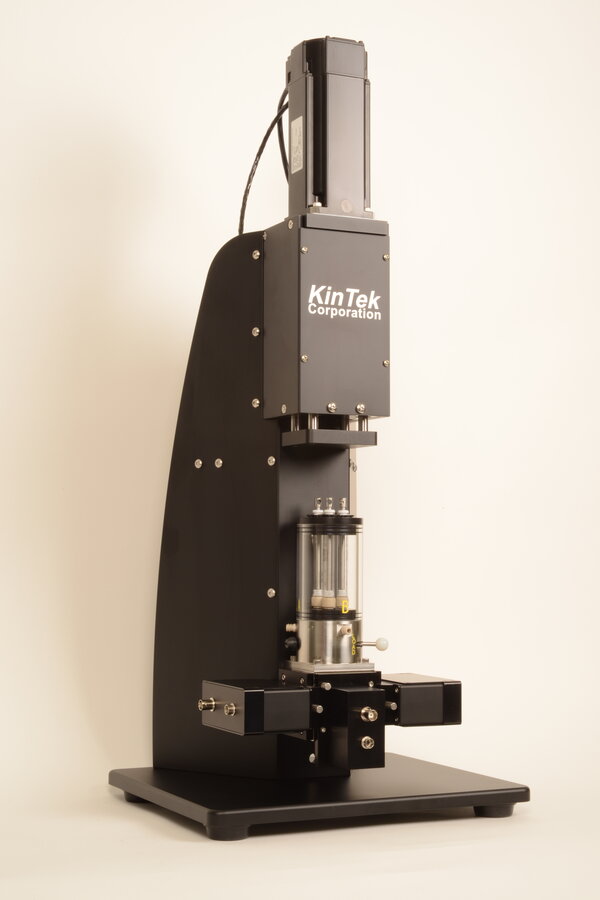
Overview
The SF-300X stopped-flow instrument represents the pinnacle of flexibility in rapid kinetics analysis.
Key Features
- Computer-controlled servo motor
- Double-mixing experiments
- Sub-millisecond dead time of 0.85 ms
- Only 20 uL per reactant per shot
Stopped-Flow Methodology
Core Principle
The stopped-flow method rapidly fires two solutions from separate drive syringes into a precision mixing device. Flow into the observation cell triggers data collection, enabling you to capture kinetic events from the moment of mixing.
Detection Capabilities
The SF-300X measures multiple optical properties:
- Absorbance: UV-Vis spectroscopy across 220-800 nm
- Fluorescence: Emission detection with selectable wavelengths
- Light Scattering: Monitor aggregation and assembly
- Turbidity: Protein folding and precipitation studies
- Fluorescence Anisotropy: T-format configuration available
Detectors can be positioned perpendicular or parallel to incoming light, with support for simultaneous multi-channel data collection.
Performance Characteristics
- Dead Time: 0.85 milliseconds (sub-millisecond)
- Micro-Volume: Only 20 uL per reactant per shot
- Single Mixing: Standard two-syringe rapid mixing
- Double Mixing: Three-syringe sequential reactions
Double Mixing Experiments
The three-syringe configuration enables sophisticated sequential mixing protocols. Two reactants mix first, react for a controlled delay, then combine with a third reactant in a second mixer. This capability is essential for:
- Pre-equilibration studies
- Sequential substrate binding
- pH-jump experiments
- Chaperone-assisted folding
- Multi-step enzymatic reactions
The delay line controls the first reaction duration before the second mixing event, all under precise computer control.
Applications
The SF-300X excels across diverse research applications including enzyme kinetics, protein-ligand interactions, and protein folding studies.
Related Products
- Auto SF-120: Automated stopped-flow with maximum sample economy
- RQF-3: Chemical quench-flow for millisecond kinetics